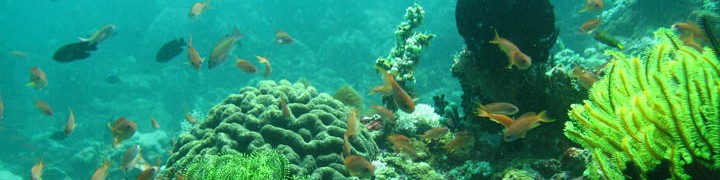
Approximately 69% of the earth’s surface is covered by salt water (while fresh water covers around 2% of the earth’s surface).  So, when one looks at a world map, most of what one sees are oceans.  This may lead one to think that since there is plenty of salt water, then there must also be plenty of coral reefs.  That, however, is not the case because coral reefs are made by colonies of tiny animals which are very sensitive to their living conditions.  Hence, coral grows in only 1% of the earth’s vast oceans.

What are the living conditions that coral animals require?  They must have clear, clean and flowing water.  Clear water is needed so that sunlight can penetrate the water and reach the microscopic, symbiotic algae (called “zooxanthellae”) living inside the coral animal.  If sunlight reaches the zooxanthellae inside the coral polyp (in a coral colony, each individual is called a coral polyp), then the zooxanthellae uses the sun’s energy to combine carbon dioxide (a waste product of the coral polyp) with water to produce carbohydrates for the coral polyp.  This process of photosynthesis provides as much as 90% of the nutritional needs of the coral animal.  In return, the coral animal provides the zooxanthellae with a place to live.

The  water must be free of sediment because each coral polyp is tiny, just as big as a pinhead.  And the coral polyp only has a single opening which multi-tasks by being a mouth, an exit for its waste, and also an exit for its eggs or sperm.  If just one grain of sediment in the water lands on this single opening and blocks it, it means sure death for the coral polyp.

Good water circulation is needed in order to provide a continuous supply of oxygen to the coral animal.  Yes, coral polyps need oxygen just like we do.

They need enough sunlight so that the zooxanthellae (the solar energy partners of coral living inside the coral) can produce food.  Since sunlight cannot penetrate to deep parts of the ocean, this limits reef-building coral (i.e., hard coral) to living in water up to a depth of around 100 feet.

Coral also require water with a salinity of  32-42 parts per million (ppm).  Thus, coral cannot live in fresh water.

Another major requirement of coral animals is the water must be of the right temperature.  They can live in water with a temperature of 18 to 29 degrees Centigrade.  If the water is too cold or too hot, they will not survive.

Because of all these requirements, coral animals and the coral reefs which they build (over hundreds of years, because they only grow 1-2 mm per year), thrive in the tropics, especially in an area called the Coral Triangle.  The Coral Triangle is bounded by the Philippines, Malaysia, Indonesia, Timor Leste, Papua New Guinea and the Solomon Islands.  This region is special because, out of the 1% of the area of world’s oceans which have coral, this place contains 30-50% of the world’s coral reefs.  And in it you can also find 75% of the world’s approximately 800  coral species.  If you are looking for coral, this is the place to go to.

In the Philippines, around 540 species of coral have been identified.  You can see some of them in detail by visiting CoenoMap.
Watch some of the amazing marine life found in the coral reefs of the Philippines! (10 minutes)

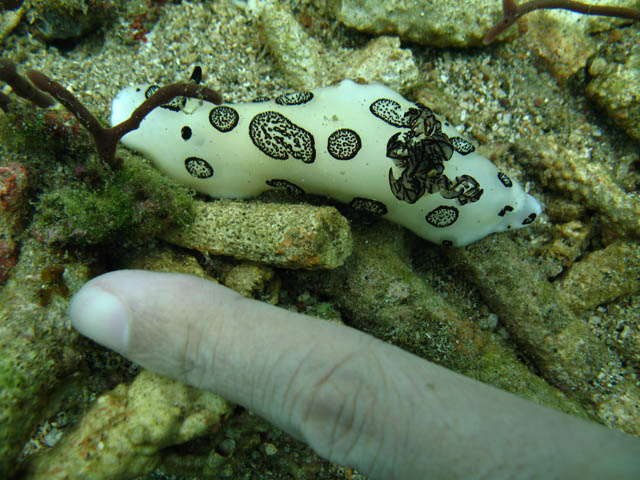
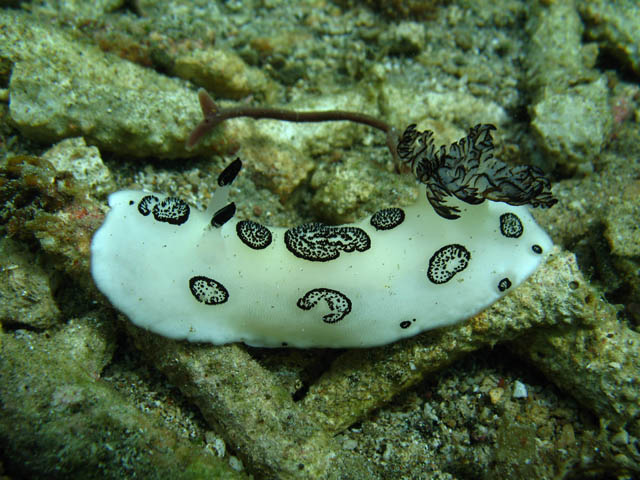
A nudibranch in Anilao, Batangas, Philippines

For most of the 24 years that I have been scuba diving, I have been on the lookout for big sea life like barracuda, jacks, sharks, sea turtles, moray eels and other reef fish.  It has only been in the past few years that I have discovered that there are so many  small  marine organisms that live on the reef bottom which are just as fascinating as the more well-known denizens of the reef.  One group of bottom-dwelling animals which fascinates me are nudibranchs (pronounced as “new-dee-branks”).  Nudibranchs are members of the mollusc family.  They are soft-bodied animals like their relatives the octopus, squid, clams, and sea snails.  Nudibranchs are also referred to as sea slugs.

While scuba diving at a depth of 4-5 meters in Twin Rocks (a dive site in Anilao in the province of Batangas in the Philippines), I was excited to find the nudibranch shown in the photo above (scientific name Jorunna funebris).  (You can see a short video clip of this nudibranch at the end of this post.)

Nudibranch means “naked gill”.  The part on its back which looks like black and white feathers are its gills.  Gills are organs which allow marine life such as fish, crabs, lobsters and sea snails to obtain oxygen from the water.  Nudibranchs are unusual because their gills are located outside their body.

Nudibranchs are usually only a few centimeters in length. Photo shows the size of Jorunna funebris in relation to my forefinger.

The appendages which look like a pair of white antennae with black tips are its sensory organs called rhinopores.  The part of the nudibranch’s body with the rhinopores is the head of the nudibranch.

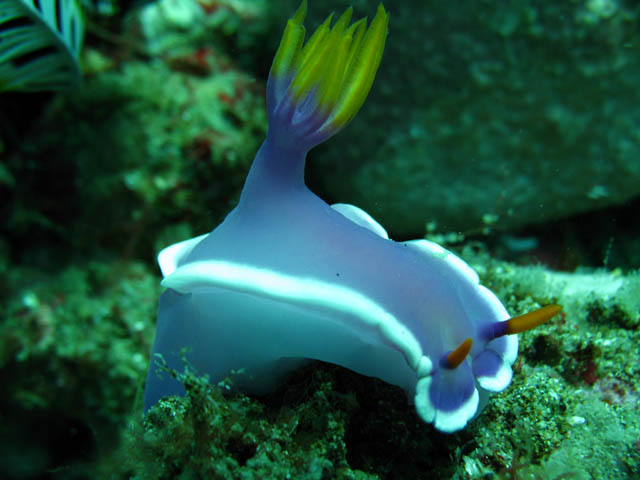
The blue version of Hypselodoris bullockii, which also comes in purple or white.

Nudibranchs are sea snails which do not have a shell.  They may seem defenseless, but that is definitely not the case.  Some nudibranchs use stealth to hide from predators.  Their color and shape blend perfectly with their environment, providing them with perfect camouflage.  On the other hand, most nudibranchs have opted for a completely opposite strategy.  Instead of trying to hide, they use bold, eye-catching colors and designs to advertise themselves to would-be predators, saying “If you eat me, you’re going to get very sick, so stay away!”

Nudibranchs are not a popular item on the menu of predators due to the ability of nudibranchs to retaliate using chemical warfare.  When disturbed, some nudibranchs secrete acids which taste awful to predators.  Others secrete toxins which can kill, not only the attacker, but also other marine life in the immediate surroundings.

There are even nudibranchs with more extreme chemical defenses.  A group of nudibranchs (called aeolids) feed on sea anemones and hydroids.  Sea anemones and hydroids have stinging cells which inject a toxin into a victim.  Aeolids, however, are not harmed by these stinging cells.  When it eats a sea anemone or a hydroid, an aeolid is able to retain the stinging cells and place them in appendages called cerata.  When a predator bites the cerata, the predator gets a mouthful of stings!  Aeolids are a perfect example of the saying “You are what you eat.”

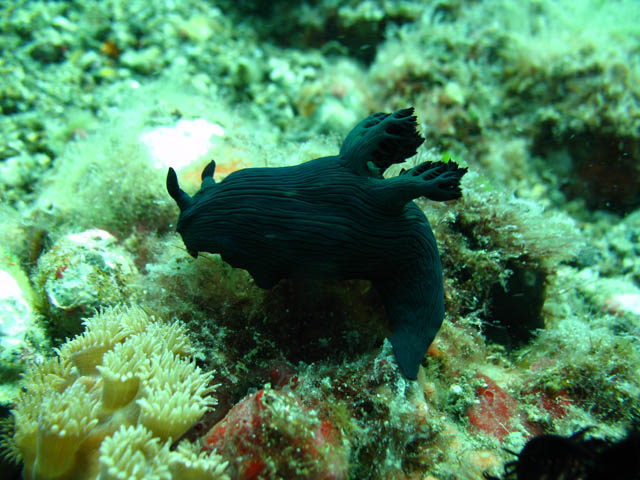
A nudibranch possibly from the Polyceridae family

Like other snails, nudibranchs eat through the use of a radula.  A radula looks like a miniature chainsaw.  The nudibranch moves its radula which cuts away at its prey.  Nudibranchs are carnivorous creatures.  Some feed on sponges and tunicates, while others prey on coral polyps, sea anemones and hydroids.  The sea tiger nudibranch, however, is very different:  it eats other nudibranchs.  When it finds its prey, it quickly brings out and expands its mouth (in exactly the same way as an activated airbag of a car).  In a few seconds, the mouth of the sea tiger envelops a part of its prey, and then the sea tiger uses its radula to pull in its victim.

Wart Slug

Nudibranchs come in all shapes and colors, with some already in the “What in the world is that?” category, like the one in the photo above.  Not surprisingly, this is called a wart slug (Phyllidia ocellata).  I took this photo during a twilight dive at a depth of 3-4 meters, also at the Twin Rocks dive site.  The wart slug does not have external gills like Jorunna funebris, but it also has rhinopores.  Can you determine where the head of the wart slug is?  Find  the rhinopores and then you will know where the head is.  The rhinopores are the pair of orange-colored appendages which look like antennae.  Were you able to find them?

(The rhinopores are towards the right side of the photo.)

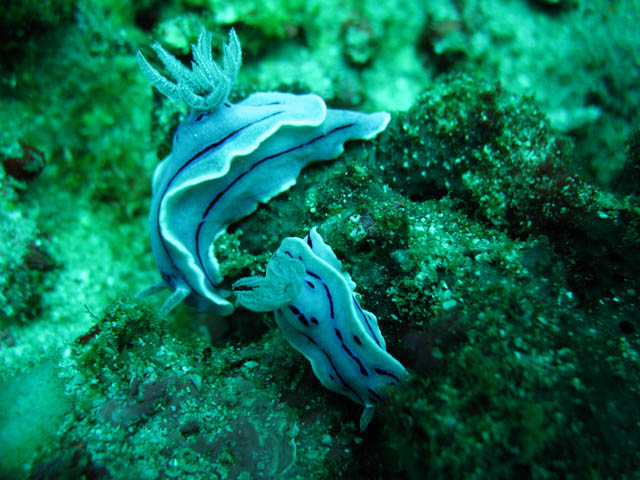
A pair of nudibranchs (possibly of the Chromodorididae family) photographed in the Bajura dive site in Anilao.

If you want to see other amazing (and even bizarre) nudibranchs, then you should visit coral reefs of the Philippines.  Dr. Terry Gosliner of the California Academy of Sciences has been studying the nudibranchs of Anilao.  In his blog “Scientist at Work” last May 2010, he said “Since 1992, we have found 684 different species of nudibranchs and their relatives from this one area, making it the richest nudibranch fauna in the world.  Not only that, more than half the species we find are new species… This is a dream come true.  Where else can you find an average of one new species per dive?”

If you are a scuba diver, you can also find nudibranchs.  The method I recommend is:  look at pictures of nudibranchs so you will become familiar with their various shapes and designs.  See as many pictures as you can by surfing the internet.  When diving:  instead of passing quickly over a reef, slow down and stay in one spot for a few minutes.  Then you will be able to notice tiny movements on the reef bottom.  Take a closer look, and with some luck, you might find one!  If you are not yet a scuba diver, consider taking up the sport to have the chance to personally see the wonderful world of nudibranchs!