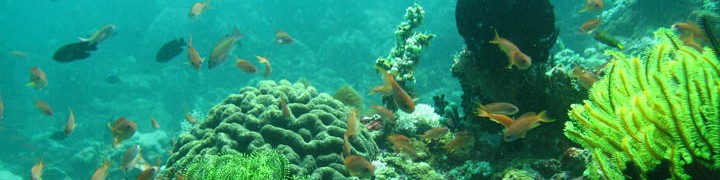
You are currently browsing the tag archive for the ‘coral reef’ tag.
Approximately 69% of the earth’s surface is covered by salt water (while fresh water covers around 2% of the earth’s surface). So, when one looks at a world map, most of what one sees are oceans. This may lead one to think that since there is plenty of salt water, then there must also be plenty of coral reefs. That, however, is not the case because coral reefs are made by colonies of tiny animals which are very sensitive to their living conditions. Hence, coral grows in only 1% of the earth’s vast oceans.
What are the living conditions that coral animals require? They must have clear, clean and flowing water. Clear water is needed so that sunlight can penetrate the water and reach the microscopic, symbiotic algae (called “zooxanthellae”) living inside the coral animal. If sunlight reaches the zooxanthellae inside the coral polyp (in a coral colony, each individual is called a coral polyp), then the zooxanthellae uses the sun’s energy to combine carbon dioxide (a waste product of the coral polyp) with water to produce carbohydrates for the coral polyp. This process of photosynthesis provides as much as 90% of the nutritional needs of the coral animal. In return, the coral animal provides the zooxanthellae with a place to live.
The water must be free of sediment because each coral polyp is tiny, just as big as a pinhead. And the coral polyp only has a single opening which multi-tasks by being a mouth, an exit for its waste, and also an exit for its eggs or sperm. If just one grain of sediment in the water lands on this single opening and blocks it, it means sure death for the coral polyp.
Good water circulation is needed in order to provide a continuous supply of oxygen to the coral animal. Yes, coral polyps need oxygen just like we do.
They need enough sunlight so that the zooxanthellae (the solar energy partners of coral living inside the coral) can produce food. Since sunlight cannot penetrate to deep parts of the ocean, this limits reef-building coral (i.e., hard coral) to living in water up to a depth of around 100 feet.
Coral also require water with a salinity of 32-42 parts per million (ppm). Thus, coral cannot live in fresh water.
Another major requirement of coral animals is the water must be of the right temperature. They can live in water with a temperature of 18 to 29 degrees Centigrade. If the water is too cold or too hot, they will not survive.
Because of all these requirements, coral animals and the coral reefs which they build (over hundreds of years, because they only grow 1-2 mm per year), thrive in the tropics, especially in an area called the Coral Triangle. The Coral Triangle is bounded by the Philippines, Malaysia, Indonesia, Timor Leste, Papua New Guinea and the Solomon Islands. This region is special because, out of the 1% of the area of world’s oceans which have coral, this place contains 30-50% of the world’s coral reefs. And in it you can also find 75% of the world’s approximately 800 coral species. If you are looking for coral, this is the place to go to.
In the Philippines, around 540 species of coral have been identified. You can see some of them in detail by visiting CoenoMap.
Watch some of the amazing marine life found in the coral reefs of the Philippines! (10 minutes)
 ReefGazer